











A Changing Composition of Equity Markets
Public equity indices have traditionally aimed to represent the broad investable ecosystem. They remain a core building block for investors seeking equity market insight, and benchmarks including the S&P 500® continue to play this role effectively. However, structural changes in capital markets suggest that public equities may not always fully reflect the entire spectrum of where value is being created.
Private markets are playing an increasingly important role in the global economy. Companies are staying private for longer, often growing to a significant scale before an initial public offering (IPO). As a result, a meaningful share of value creation can occur outside of public markets.
Fewer Public Companies, More Private Capital
In 2000, there were approximately 12,700 publicly listed companies across the U.S. and Europe. By 2024, that number had declined to around 8,600, representing a reduction of roughly 32% (see Exhibit 1). The number of private equity-backed companies increased from about 1,400 in 2000 to more than 10,000 by 2020—a sevenfold increase.1 These figures also highlight the extent to which corporate activity has shifted toward private ownership structures.

IPO activity is lower than in the 1990s, and firms have tended to go public at a more mature stage. As a result, an increasing share of value creation is occurring before companies reach public markets, meaning many investors are accessing these businesses only after a substantial portion of their growth has already taken place.
Large and Influential Companies outside Public Markets
The presence of large, systemically important private companies further illustrates this shift. Firms such as OpenAI, Anthropic and Databricks have achieved significant scale and influence while remaining privately held. Their absence from public benchmarks highlights a potential gap between index representation and the evolving structure of the economy.

Development of Public-Private Blending
These observations have contributed to growing interest in combining public and private exposures. In equities, integrating public and private companies within a single framework can provide a more complete view of growth across different stages of the company lifecycle.
A similar dynamic can be observed in credit markets, where public-private blended strategies are emerging. In this context, the rationale is less about reflecting growth and more about accessing a broader opportunity set, including the higher yield potential historically associated with private credit. Recent developments, such as blended exchange-traded credit funds, reflect this broader convergence between public and private market segments.
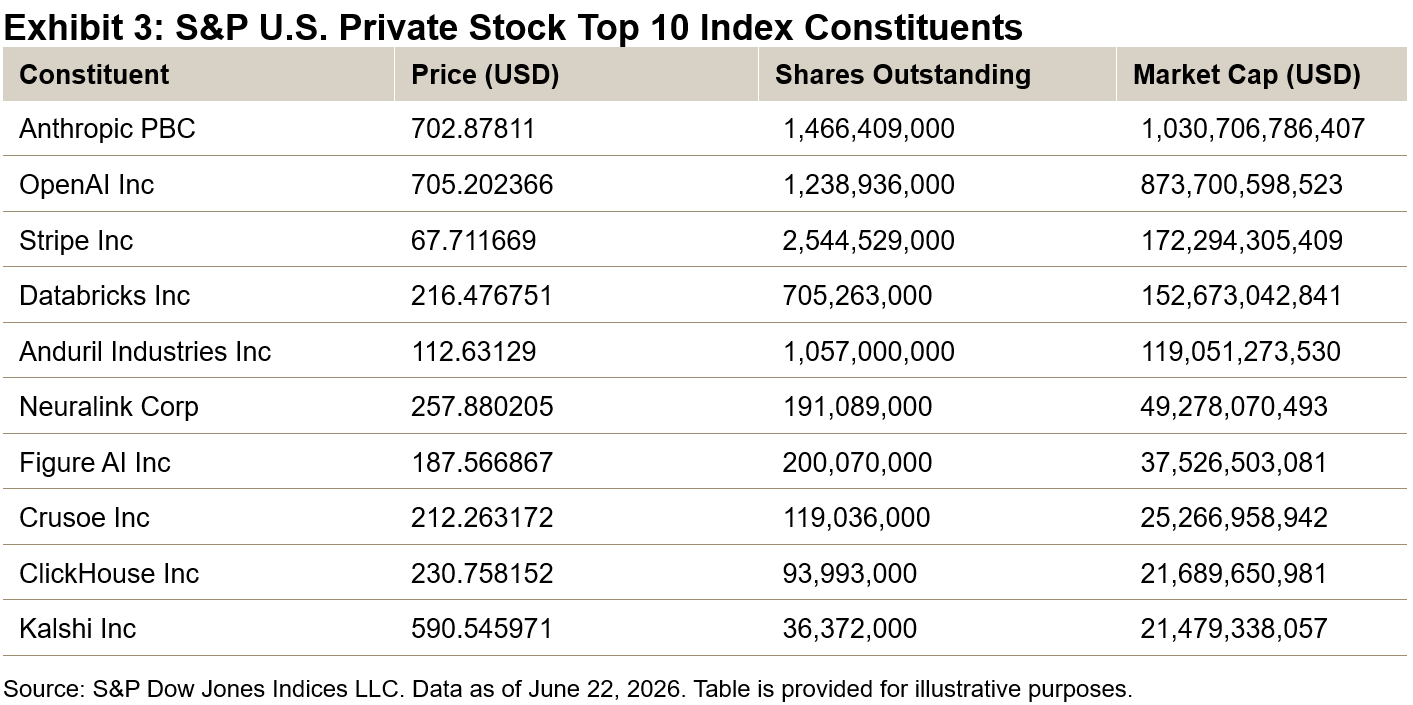
One possible extension is a blended equity composition incorporating both public and private companies. A structure consisting of a broad public benchmark blended with the S&P U.S. Private Stock Top 10 Index—which is part of the broader S&P Private Stock Index Series and measures the performance of the 10 largest private companies in the U.S. (see Exhibit 3)—may offer a practical framework for a strategy. The S&P Private Stock Index Series also includes benchmarks covering different regions and varying cohorts of leading private companies, enabling scalable public-private combinations across geographies and market segments.
Liquidity rules for funds vary by region, but most frameworks limit exposure to illiquid assets, typically keeping allocations in the low double-digit range. This means private assets can be included in traditional mutual funds or ETFs, but usually only at modest levels in line with local regulatory constraints.
At the same time, newer fund structures designed for less liquid investments—such as evergreen or semi-liquid vehicles—may have greater flexibility, allowing for higher allocations to private markets than traditional daily dealing funds.
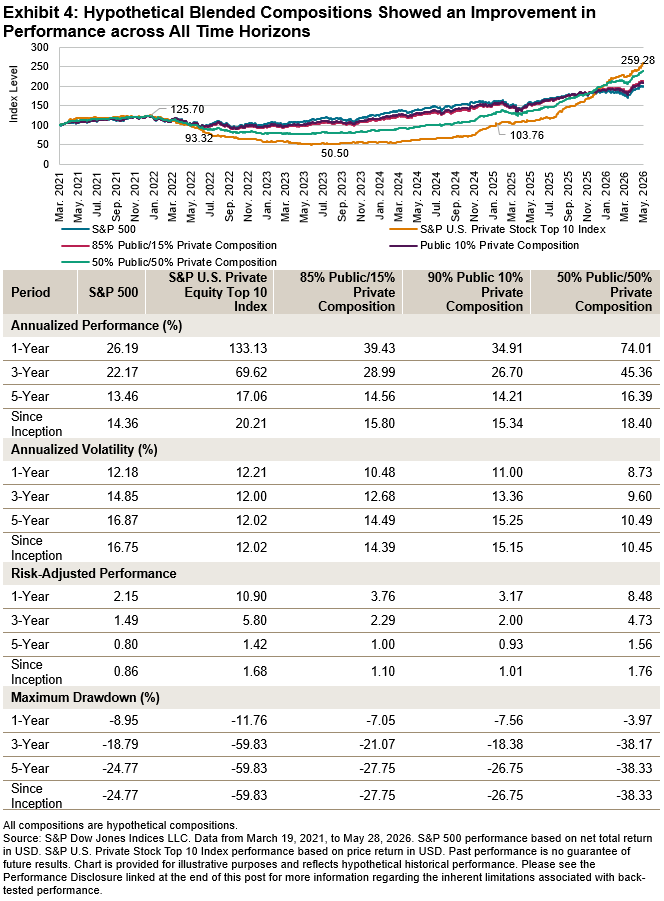
The scenarios in Exhibit 4 illustrate how hypothetical blended compositions showed improved performance over time.
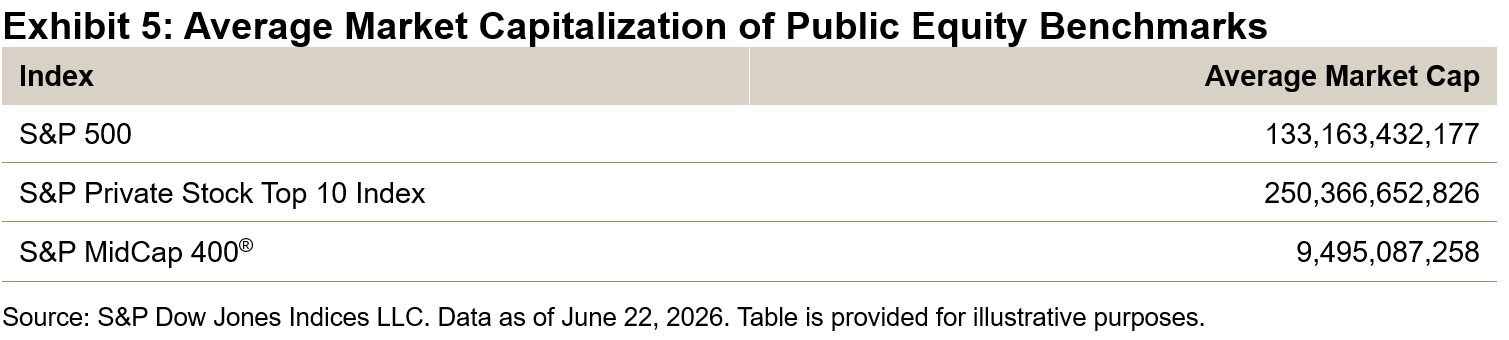
Secondary market developments also suggest that liquidity conditions are improving among the largest private companies.2 This is particularly relevant for the largest constituents represented in emerging private stock indices, where company scale, institutional ownership and secondary market activity may contribute to more observable pricing than in the broader private market universe. The constituents of the S&P Private Stock Top 10 Index have also tended to have average market capitalizations greater than those of mid-cap public equities while remaining lower than the largest constituents of the S&P 500 (see Exhibit 5). This combination of scale and secondary market liquidity may support their inclusion in index-based structures and improve their compatibility with ETF implementation.
A comprehensive representation of the investable equity universe may enable investors to assess both the largest public companies and leading private firms increasingly shaping the global economy—particularly considering that innovation cycles, such as those driven by AI, are often initiated in private markets before scaling into public market leadership. Reflecting both dimensions may therefore lead to a more complete and forward-looking perspective on growth.
1 MEKETA, “The Decreasing Number of Public Companies,” September 2024.
2 J.P.Morgan, “Private market secondaries are booming amid an IPO slowdown,” April 13, 2026.
The posts on this blog are opinions, not advice. Please read our Disclaimers.